Going direct offshore is tempting. The headline cost is lower, the control feels greater, and the logic seems straightforward: hire a bookkeeper in India or South Africa, save on salary costs, problem solved. It's possible. But the hidden costs and risks are significant and most practices that try it find that the savings are largely absorbed by the overhead of running the arrangement themselves.
What actually happens
- No SOPs means inconsistent output. The offshore team can only work to the process you give them. If your processes live in the partner's head rather than in documented SOPs, the team defaults to guessing. Rework follows.
- Quality control falls back on you. Someone senior has to review everything coming back, catch the errors, and decide whether to correct and resend or absorb the mistake. That review overhead is real and it never fully goes away.
- Turnover offshore is high. You invest weeks training someone on your clients, your systems, your standards and then they leave. You start again. The institutional knowledge you built walks out with them.
- Time zone and communication friction adds management overhead. Queries don't get answered in real time. Work sits waiting for a response. Small miscommunications compound into bigger errors.
- GDPR and data security obligations still apply. Client data processed offshore requires appropriate safeguards, data processing agreements, and client consent in some cases. Getting this wrong is not a minor issue.
- It takes 3–6 months before productivity reaches a useful level. During that period the practice is still carrying the work while also managing onboarding. The cost is time, not just money.
- The choice between direct offshore hiring, an EOR arrangement, and a managed provider isn't straightforward and the wrong call only becomes obvious once you're committed to it.
The pattern
Over 50% of accountancy firms are expected to outsource some or all accounting tasks by 2030. But the firms that do it successfully tend to use managed providers rather than build their own offshore function. The reason is simple: the managed layer is what makes outsourcing work. Without it, the practice becomes the account manager, the quality controller, and the HR department on top of everything else.
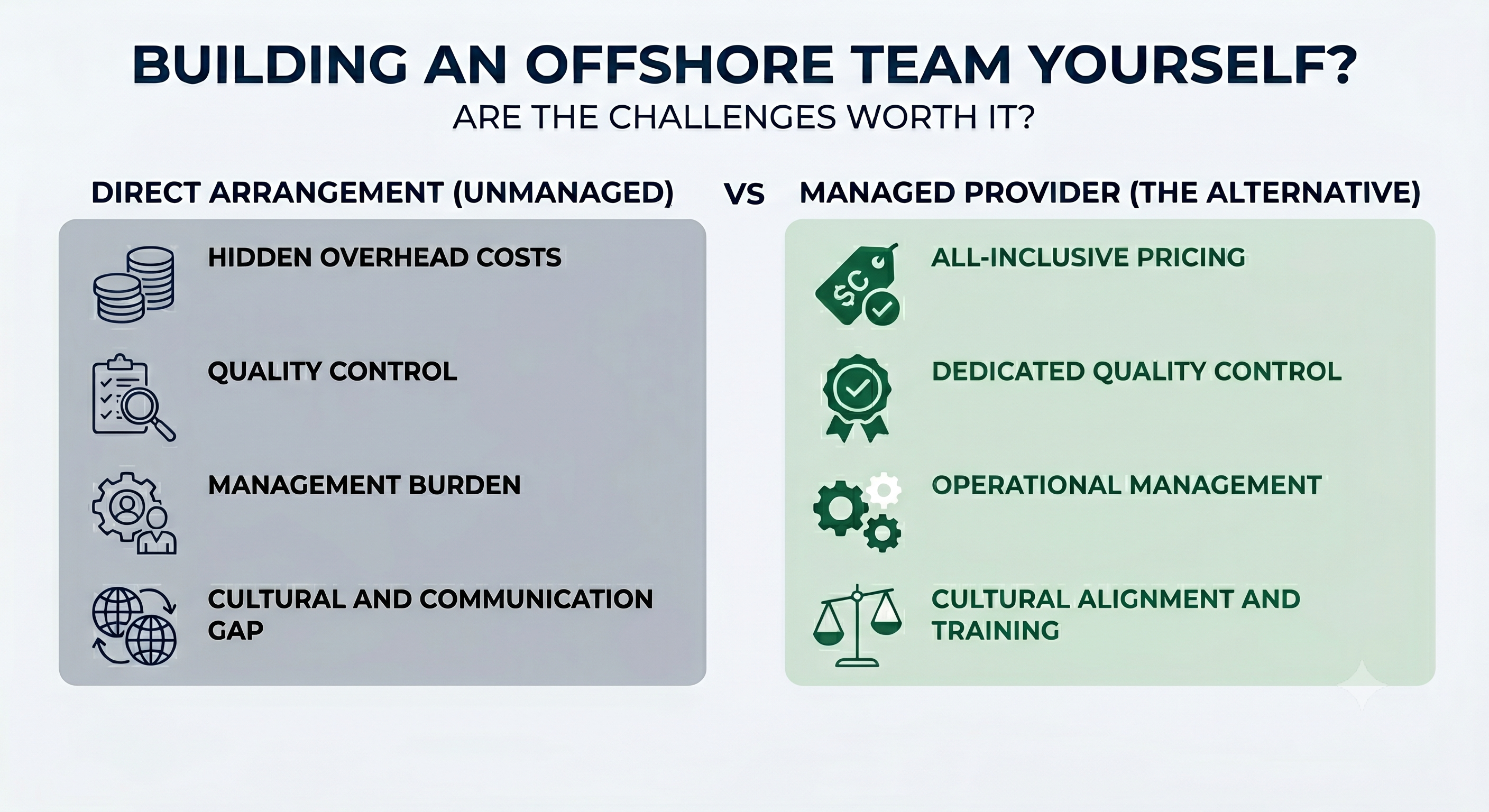
The alternative
A managed outsourcing model means the provider carries the recruitment, training, quality control, and day-to-day management overhead. The practice gets the output. The management layer sits between you and the offshore team, so you're not in the engine room.
The cost differential between going direct and using a managed model is narrower than it looks once the true cost of running an unmanaged arrangement is accounted for. And the risk differential is significant.