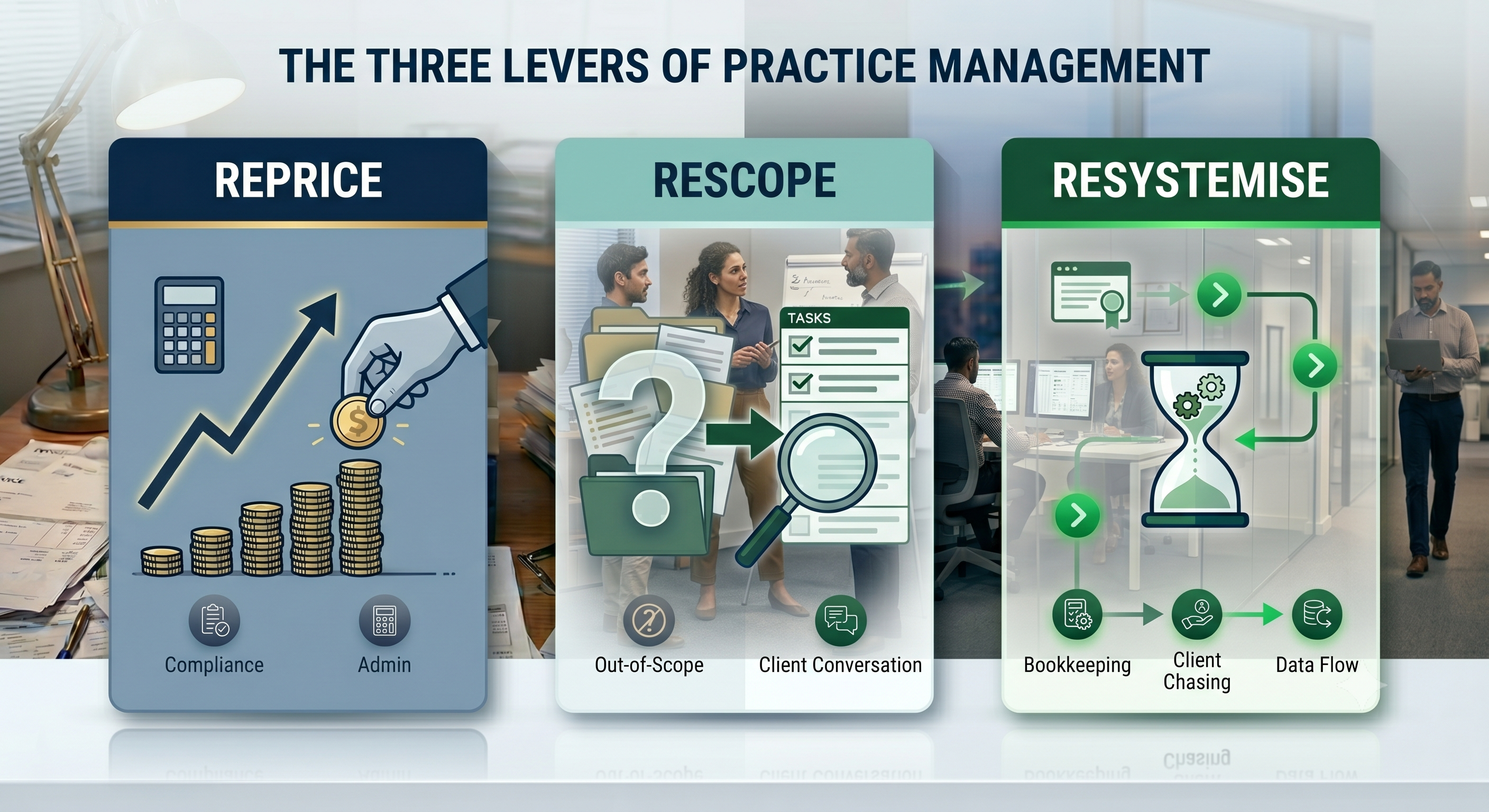
The good news is that margin leakage almost always comes from one of three places. Once you know which lever to pull, the fix is usually straightforward.
The Three Levers
Reprice
Have your fees kept pace with the actual work involved? For many practices, the answer is no, particularly where sector-specific admin has grown over time. Bolt-ons for regulatory filings, compliance checklists, or client-specific reporting are often done without ever being charged for. A simple fee-to-hours review across your client list will surface these gaps quickly.
Rescope
Are you doing work that's genuinely out of scope or that could simply stop? Low-value outputs that made sense when a client relationship was new often persist long after anyone needs them. Rescoping isn't about cutting corners. It's about having an honest conversation with the client about what's actually useful and who should be doing it. Nine times out of ten, it shouldn't be the partner.
Resystemise
Manual processes are the quietest drain on capacity. UK accounting practices lose an average of 15+ hours per week to routine bookkeeping tasks alone and that's before accounting for the time spent chasing clients for records, correcting messy data, or fielding queries that shouldn't reach senior staff. A structured workflow eliminates most of this without touching the quality of the output.
Running the Diagnosis
You don't need to audit your whole client base to find the leaks. Pick two or three clients you already suspect are heavy. For each one, assess where the hours are actually going then decide which lever applies.
Most practices find that the same two or three issues keep appearing across different clients. That's not a coincidence; it's a system problem, and it's fixable.
Where RFP Fits
RFP sits primarily in Lever 3, resystemising the bookkeeping and practice admin work so that hours come back to the practice rather than disappearing into process. We can also support Lever 2 by removing low-value tasks from a partner's plate. We get it done and unlock capacity within your firm.
The capacity that's freed doesn't have to go anywhere dramatic. It can flow toward better clients, toward advisory work that commands a higher fee, or simply toward a more manageable workload for the team doing the work.