You built your practice around your own expertise. That's the asset and the problem. When every piece of work flows through you, growth hits a ceiling that can't be raised by working harder. There are only so many hours.
74% of accountants reported experiencing burnout at least sometimes in 2024. I would wager it has only gotten worse. Sole practitioners are disproportionately affected not because they're less capable, but because there's nobody else to absorb the overflow when demand spikes.
The trap
The logic is circular and it's very hard to break from the inside. You need more revenue to justify hiring. But you need help to generate more revenue. And hiring feels too risky: the cost, the management overhead, the HR risk, the training time, so most sole practitioners absorb the workload themselves and stay stuck.
Meanwhile, the talent market has made it worse. Smaller practices can't match the salary packages that larger firms offer, so when a good candidate comes along, they rarely choose the sole practitioner. Recruitment timelines have lengthened by 40–60 days compared to pre-2020 levels. Many positions stay unfilled for months.
The result: you're doing everything, the work you should be doing is competing with the work anyone could be doing, and the practice doesn't grow because the bottleneck is you.
The three escape routes
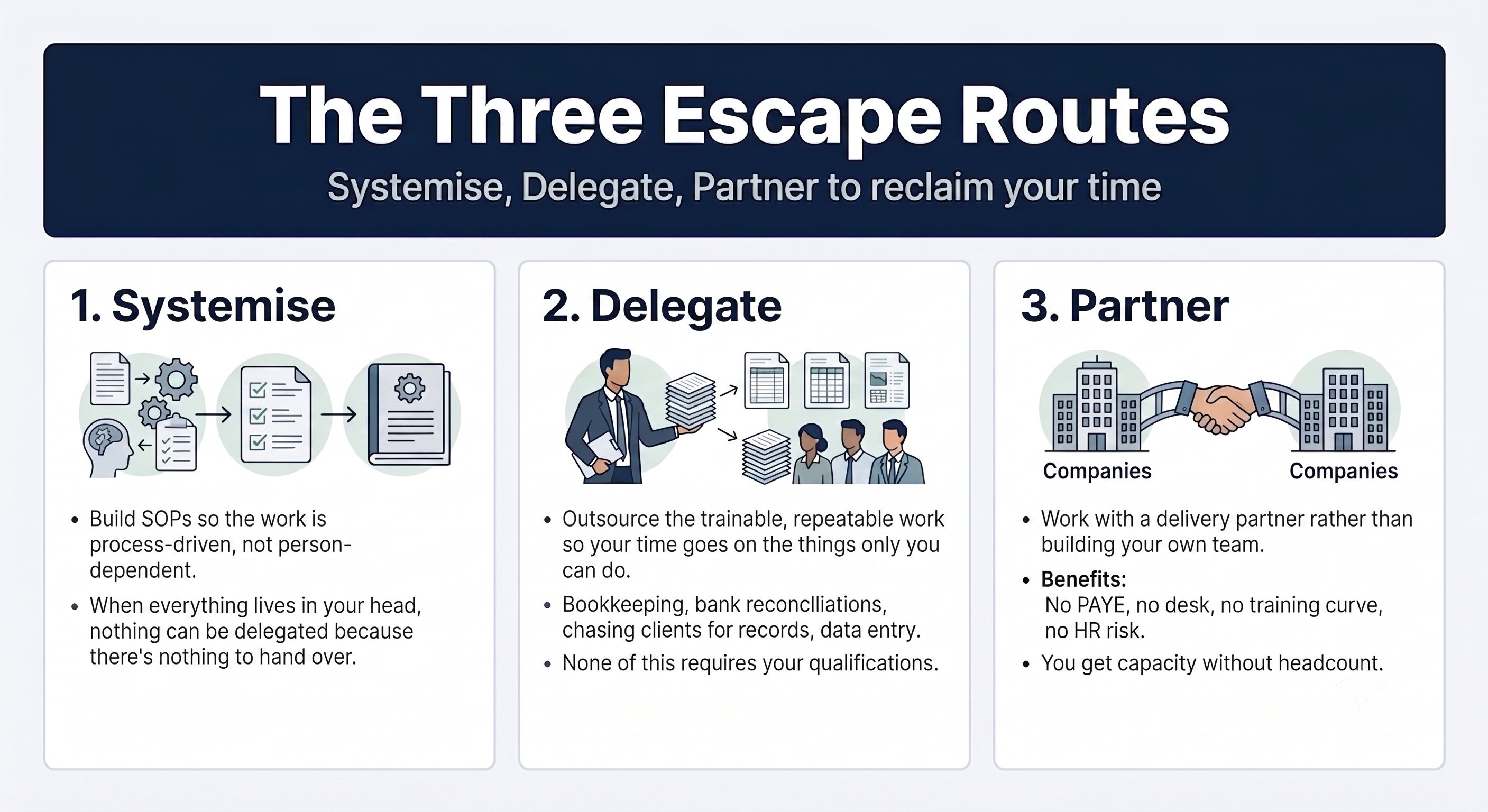
- Systemise: build SOPs so the work is process-driven, not person-dependent. When everything lives in your head, nothing can be delegated because there's nothing to hand over.
- Delegate: outsource the trainable, repeatable work so your time goes on the things only you can do. Bookkeeping, bank reconciliations, chasing clients for records, data entry: none of this requires your qualifications.
- Partner: work with a delivery partner rather than building your own team. No PAYE, no desk, no training curve, no HR risk. You get capacity without headcount.
What this looks like in practice
The work that clogs a sole practitioner's week is almost always the same: bookkeeping that didn't arrive clean, records that need chasing, admin that piles up between filing deadlines. It's not complex. It's just time-consuming and it crowds out the client conversations and advisory work that would actually grow the practice.
Taking that layer off your plate doesn't require a hire. It requires a process and a team trained to run it. The output lands on your desk ready to review. You stay in control of the client relationship and the professional judgement. Everything underneath runs without you.
The result
Time back for the work that only you can do. A practice that can take on more clients without breaking. And a week that looks like the reason you went out on your own rather than the version where you're managing admin until 9pm.